
Erling Haaland Playing Style: An In-Depth Tactical and Technical Analysis
In modern football, Erling Haaland represents a unique tactical presence. He is neither a traditional target man who plays with his back to goal and waits for crosses, nor a false nine who frequently drops deep to receive the ball and vacate the penalty area. Instead, he combines an elite physical profile, deceptive off-the-ball movement, and minimalist finishing efficiency to become an unprecedented "ultimate finisher."
From a devastating counterattacking weapon at Borussia Dortmund to a penalty-box predator within Manchester City's possession-based system, Haaland's playing style has not only helped his teams win major honors such as the Premier League and UEFA Champions League, but is also reshaping how modern football understands the role of the No. 9. This article takes an in-depth look at Haaland's technical characteristics and tactical value.
Physical Profile and Athleticism: An Unfair Physical Advantage
Haaland's tactical threat begins with his extraordinary physical attributes.
The Rare Combination of Size and Speed
In football, forwards standing over 1.94 meters are typically known for strength and aerial ability, often at the expense of outright speed. Haaland breaks that physical convention. He possesses an enormous stride length while also having elite acceleration and top-end speed, with his maximum sprint speed recorded at over 36 km/h.
This combination of being both tall and fast means defenders struggle to gain an advantage against him either physically or in a foot race.
Core Strength and Dynamic Balance
Beyond straight-line speed, Haaland's ability to maintain his balance and produce high-quality shots after intense physical contact with defenders at high speed is equally remarkable. This is supported by his exceptional core strength, which is closely connected to his demanding diet and recovery management.
He does not always need to completely escape his marker before shooting. Instead, he can use his body to shield the ball during physical challenges and create shooting angles through sheer strength and balance.
Off-the-Ball Movement and Spatial Awareness: A Ghost-Like Penalty-Area Instinct
If Haaland's physical attributes are his hardware, then his off-the-ball movement is his most dangerous software. He can go through long stretches of a match with relatively few touches while repeatedly appearing in the most dangerous positions at the most decisive moments.
Blind-Side Runs and Beating the Offside Trap
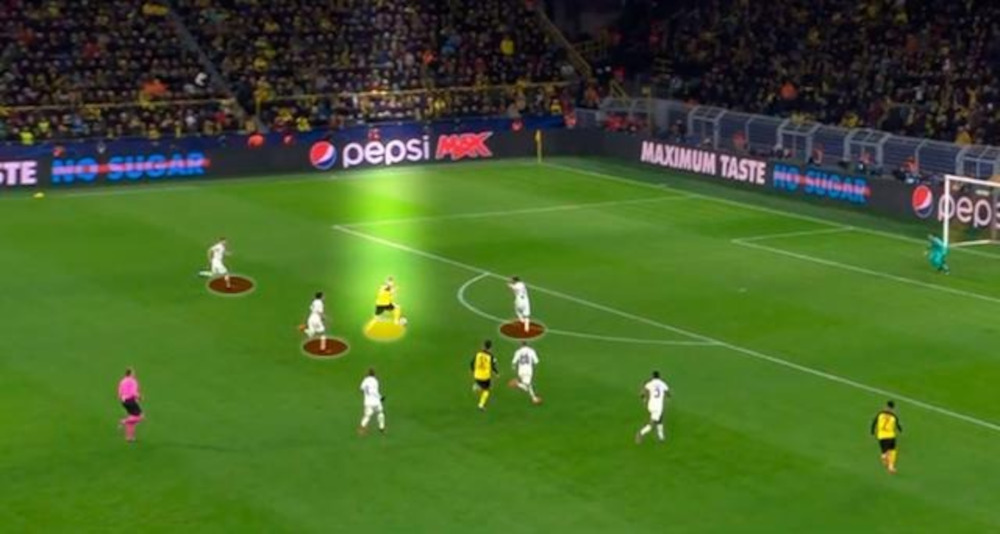
Haaland is exceptionally good at exploiting the blind side of central defenders. Just before a teammate is ready to deliver a pass, he subtly moves behind or to the side of the defender's field of vision. As the pass is played, he uses his explosive first step to accelerate.
This movement makes it extremely difficult for defenders to react in time and allows him to operate constantly on the edge of the offside line.
Attacking the Space Behind
Against teams that push their defensive line high, Haaland is a natural counter. He does not need elaborate dribbling. A precise through ball from a teammate is often enough for him to attack the space behind the defense with his long stride and turn a tactical opening into a clear scoring opportunity.
False Drops and Second Runs
In Manchester City's positional attacks, Haaland has also demonstrated a more sophisticated understanding of movement. He occasionally uses decoy runs, brief drops toward the ball, or lateral movements to create space.
However, his primary value remains his ability to maintain a constant threat behind the defensive line. After completing his movement to create space or drag defenders away, he can quickly turn and make a second run into the penalty area to attack cutbacks and crosses.
Finishing Mechanics: The Minimalist and Highly Efficient Killer
Inside the penalty area, Haaland's philosophy is essentially minimalism. His style naturally minimizes unnecessary touches.
The Minimal-Touch Principle
A large proportion of Haaland's goals come within one or two touches. His receiving, adjustment, and finishing movements are often completed in one fluid sequence, with almost no unnecessary actions.
This minimalist approach dramatically reduces the goalkeeper's reaction time.
A Diverse Finishing Arsenal
Although Haaland is famous for powerful shots, his finishing repertoire is actually highly diverse:
- Poacher's tap-ins: He has an exceptional instinct for anticipating rebounds, loose balls, and crosses in crowded areas around the goal.
- Driven low shots: He can generate enormous power through his lower body and strike low shots that are extremely difficult for goalkeepers to reach.
- Long-range shooting: Most of his finishing takes place inside the penalty area, but his ability to handle the ball and create shooting opportunities from outside the box has also developed as his technique has matured.
Two-Footed Finishing
Although Haaland primarily favors his left foot, his right foot is also highly effective. This two-footed ability means defenders cannot simply force him onto one side and expect his finishing threat to disappear.
Hold-Up Play and Attacking Link-Up: Evolution Beyond a Pure Goalscorer
Early criticism of Haaland often centered on whether he was merely a player who "finished chances." As his tactical understanding has developed, however, he has demonstrated an increasing ability to function as an attacking focal point.
Hold-Up Play and Ball Protection
During his Manchester City career, Haaland has gradually improved his ability to hold the ball with his back to goal and act as a reference point in possession.
He can use his broad frame and lower-body strength to withstand pressure from central defenders, secure possession, and give Kevin De Bruyne or advancing midfielders valuable time to join the attack.
One-Twos and Lay-Offs
His understanding with Kevin De Bruyne has been one of the Premier League's most dangerous attacking combinations.
Haaland is not limited to finishing the final move. He can also recognize the positions of nearby teammates and use precise backheels or one-touch lay-offs to create classic one-two combinations around the penalty area.
Tactical Adaptability and Career Evolution
Haaland's playing style has never been completely static. It has evolved according to his environment, tactical system, and the defensive approaches he faces.
Borussia Dortmund: A Devastating Counterattacking Weapon
At Dortmund, Haaland frequently faced opponents who committed numbers forward, creating large areas of space behind their defensive lines.
During this period, his style was particularly suited to transitional football. He relied heavily on rapid attacking transitions, open spaces, and his exceptional acceleration and top-end speed to overwhelm defenders.
Manchester City: The Penalty-Box Predator in Guardiola's System
At Manchester City, the tactical environment is different. City often dominates possession, while opponents respond with extremely deep defensive blocks.
With less open space available inside and around the penalty area, Haaland has had to reduce his reliance on long-distance runs and improve his movement in tighter spaces.
He has increasingly relied on subtle changes of direction, sharp stops and starts, intelligent positioning, short passing combinations, and quick movements around defenders to create scoring opportunities.
Mental Characteristics: The Killer Instinct of an Elite Striker
Technique can be trained, but killer instinct is much harder to teach.
- Extreme hunger for goals: Haaland has an almost obsessive desire to score. When he misses a major opportunity, he often shows visible frustration, but that emotion quickly turns into an even stronger desire to attack the next chance.
- Composure under pressure: Whether in decisive Champions League knockout matches or from the penalty spot, Haaland's technical execution rarely breaks down under pressure. His ability to remain composed in high-pressure situations is one of the characteristics separating elite superstars from merely excellent goalscorers.
Limitations and Defensive Strategies Against Haaland
No player is perfect, and opponents continue to develop tactical methods to limit Haaland's impact.
Becoming Less Involved When Touches Are Limited
Because Haaland's movement is highly specialized, he can sometimes appear isolated when his team's midfield loses control and cannot consistently deliver the ball into dangerous areas.
He may go through long periods with relatively few touches, meaning his threat is heavily dependent on the quality and timing of service from his teammates.
Challenges Against Extreme Low Blocks
When opponents surrender possession and place large numbers of players around the penalty area, Haaland has less space in which to exploit his acceleration.
In these situations, he may rely more heavily on teammates, such as wingers beating their markers and delivering crosses or midfielders shooting from distance, to disrupt the defensive structure. His own aerial ability and instinct in crowded areas also become more important.
Injury Management and Workload Control
Haaland's explosive style places significant physical demands on his muscles, particularly his hamstrings and feet.
Scientific workload management during congested periods is therefore an important long-term challenge if he is to maintain his peak performance and minimize the risk of muscular injuries.
Conclusion: The Benchmark for the Next Generation of No. 9s
Erling Haaland's playing style represents a remarkable combination of extraordinary physical gifts and elite football intelligence.
He has demonstrated that a modern center-forward does not necessarily need to constantly drop deep and participate in elaborate possession sequences. By taking off-the-ball movement and clinical finishing to an extraordinary level, a striker can become one of the most decisive forces on the pitch.
Haaland has not only changed the attacking dimension of Manchester City and completed a crucial piece of their tactical puzzle; he is also establishing a new and exceptionally difficult benchmark for young forwards developing in academies around the world.
FAQ: Frequently Asked Questions About Haaland's Playing Style
Q: What is Erling Haaland's biggest technical strength?
A: Haaland's greatest strength is the combination of his elite physical profile—particularly his size and speed—with minimalist finishing efficiency. He can often produce a high-quality shot within just one or two touches, while his off-the-ball movement is exceptionally difficult to track.
Q: Why is Haaland's off-the-ball movement so difficult to defend?
A: He is exceptionally good at exploiting the blind side of central defenders and timing his acceleration along the offside line. Defenders can often realize only after the pass has been played that Haaland has already gained a positional advantage.
Q: How is Haaland's playing style different at Manchester City compared with Borussia Dortmund?
A: At Dortmund, Haaland relied more heavily on open space and rapid counterattacks. At Manchester City, he has had to deal more frequently with deep defensive blocks, leading him to develop his hold-up play, link-up ability, short movements, and finishing in congested areas.
Q: Is Haaland a left-footed or right-footed player?
A: Haaland primarily uses his left foot, but his right foot is also highly effective. His ability to finish with either foot makes it difficult for defenders to neutralize him simply by forcing him onto his weaker side.
Q: How do teams typically try to limit Haaland tactically?
A: Opponents often use deep defensive blocks to reduce the space available for his explosive runs. They may also assign a strong central defender to engage him physically while attempting to disrupt his balance before he receives the ball and cut off through-ball passing lanes from midfield.
Continue Exploring Erling Haaland's Career and Tactical Evolution:
- 📖 Erling Haaland Biography: His Complete Life and Career Story
- 🟡 Haaland at Borussia Dortmund: The Counterattacking Weapon and Tactical Development
- 🔵 Haaland at Manchester City: The Ultimate Finisher in a Possession-Based System
- 📊 Erling Haaland Career Statistics: Detailed Club and International Data